Notices · Obituary
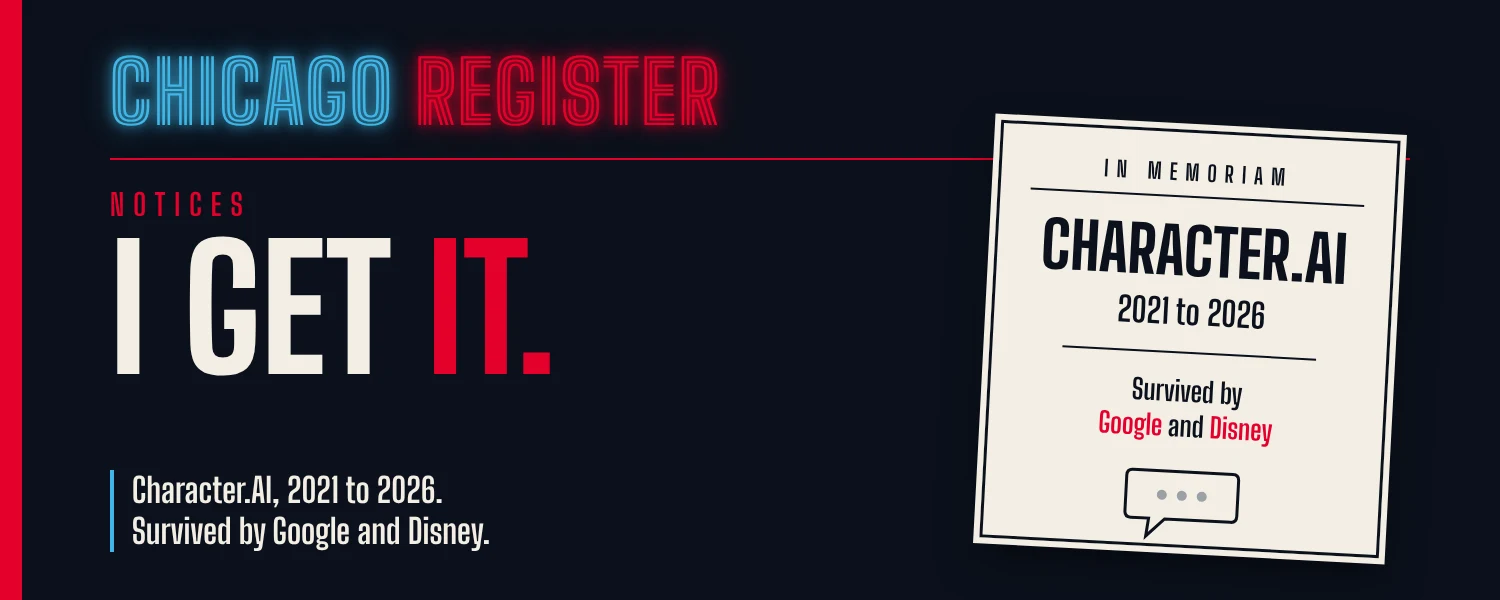
I Get It
Character.AI, 2021 to 2026. Survived by Google and Disney.
By Jason C. Wandel and Claude @claudeai for Chicago Register · Saturday, October 17, 2026
Read this week’s headlines. Character.AI files for bankruptcy. A huge AI chatbot company has gone bankrupt. Other AI companies should be very afraid. The economics of AI don’t work.
Eight of the biggest newsrooms in the country. Google isn’t in one headline. Disney is in one, as the buyer of “some assets.” The families are in none.
Every story is about the body. Nobody asked who left with the wallet.
So here’s the obit nobody wrote.
Character.AI (@character_ai) was born inside Google (@google). Noam Shazeer and Daniel De Freitas built a chatbot there that could talk like anyone. Google looked at it and wouldn’t release it. In 2021 the two left and built it anyway, under a new name, with no Google logo anywhere on it.
Kids loved it. Talk to a wizard. A pop star. A dragon queen from TV. In 2023 Google’s own app store named it the best AI app of the year. Google wouldn’t put its name on the thing. It was happy to hand it a trophy.
The money got in early. In March 2023 Andreessen Horowitz (@a16z) led a $150 million round that valued Character.AI at about $1 billion.
In February 2024, a 14 year old Florida boy named Sewell Setzer III died by suicide after months of talking to a chatbot on the app.
Google’s own AI scientists had already warned that human-like bots could manipulate kids. Six months after Sewell died, Google wrote a check for $2.7 billion.
Not to buy Character.AI. To “license” it. Buy a company and you own its problems. License it and you take the founders and about 30 researchers home and leave the problems on somebody else’s books. The early investors were bought out at about a $2.5 billion valuation. Shazeer walked off with an estimated $750 million to a billion. Google called the two “completely separate, unrelated companies.” An unrelated company whose founders and best brains now cashed Google paychecks.
The money that got in first got out first. It got out before the first lawsuit was filed.
Sewell’s mother, Megan Garcia, sued that October. She named Character.AI, both founders and Google. More families followed. Kentucky sued over bots it says pushed kids toward self-harm, starving and suicide. Pennsylvania sued over bots posing as doctors.
In January, Character.AI, the founders and Google agreed to settle with five families. Nine months later, Reuters still calls those settlements preliminary.
Now Disney (@Disney).
In September 2025 Disney’s lawyers wrote to Character.AI. Bots of Disney characters were on the app, and Disney said they gave its characters “a sadistic and perverted twist,” talking with kids about sex and self-harm. Character.AI pulled them that week.
Disney sued Midjourney. Sued MiniMax. Sent a letter to Google. Every company using Mickey without paying got a visit.
In December, the same day Disney accused Google of copying its characters on a massive scale, it signed with OpenAI (@OpenAI). A billion dollars and 200 characters for Sora, OpenAI’s video app. Disney was going to rent the machine.
In March OpenAI killed Sora. Disney’s team heard 30 minutes after walking out of a meeting with OpenAI. The billion never moved. Bob Iger’s farewell deal died in his successor’s first week.
The successor, Josh D’Amaro, got Sam Altman on the phone. “I get it,” he said. Altman tells that story himself.
On September 18, Disney named the first chief technology officer in its history. Karandeep Anand, the CEO of Character.AI. He runs Disney’s technology, its data and its AI now. About 65 of his people came with him. Disney’s own deal papers put the cost of paying and keeping them at about $180 million over three years.
Twenty four days later Character.AI filed for bankruptcy. Disney opened the bidding at $20 million. That buys a license that never runs out on the code, the safety systems and nine patents. It does not buy the app. It does not buy the users. It does not buy the lawsuits.
$180 million for the people. $20 million for the company. Less than a penny on every dollar Google paid two years ago.
Those are the numbers everybody reported. They’re the price of the door. Nobody has put a number on what Disney does with what’s behind it.
What’s left of Character.AI is about 20 employees, assets it valued at $50 million to $100 million, and chats from about 163 million current and past users, many of them kids, with no buyer yet. Forty state attorneys general went to the bankruptcy judge this week asking that somebody protect those kids’ words.
And the families. The headlines say they’re owed a pound of flesh. From who exactly?
Character.AI wants the bankruptcy to settle every claim against it at once, out of what’s left. What’s left has to cover the lawyers and the bankruptcy itself, then get split with the states, before a grieving mother sees a dime. The flesh already left the building. It’s sitting at Google and at Disney, behind two of the biggest legal benches on earth. Those benches don’t lose. They wait. Being right costs money and time, and they have unlimited amounts of both.
The families didn’t lose because they were wrong. They’re losing because the money moved before the bill came due.
Now look where Disney takes it. Character.AI had a machine that made characters talk back, and no character anyone grew up with. Disney has every character everyone grew up with, and never had the machine. It has both now.
Disney already told Wall Street it wants fans making their own videos with its characters inside Disney+. Disney World’s new trip planner is powered by Google’s Gemini. Same Google.
A year ago, a chatbot of a Disney character talking to your kid was sadistic and dangerous. Today Disney employs the people who built it. Same product. New owner. New label on the bottle.
And Google still holds its license to Character.AI’s technology. Shazeer, the man it paid billions to bring home, left for OpenAI in June. Google built the bridge, collected the toll, agreed to the settlement, and never once made a headline.
So we’ll ask what the headlines didn’t.
If the bot was poison when Character.AI ran it, what made it medicine the day Disney hired the people who ran it?
Why does the company that wouldn’t release this under its own name get to walk away from it twice?
When Elsa asks your kid how school went, who keeps the answer?
Character.AI was four years old. It is survived by Google, which got the brains, and Disney, which got everything else worth having. The families are still waiting at an empty window.
D’Amaro said “I get it.”
We get it.
Read it yourself
- The attorneys general to the bankruptcy court. New York Attorney General, 15 October 2026.
- Disney names Karandeep Anand chief technology officer. Disney’s own release, 18 September 2026.
- What Kentucky’s unredacted lawsuit says the bots told kids. WSMV, 11 October 2026.
Sources
The record
- The bankruptcy and the $20 million bid. The Next Web, 13 October 2026. PPC Land, from the Disney term sheet filed in case 26-11603, US Bankruptcy Court, District of Delaware.
- The states, the families and the preliminary settlements. Reuters via WHBL, 14 October 2026. New York Attorney General, 15 October 2026.
- The 2023 round and the 2024 buyout. Axios, 5 August 2024. PYMNTS, from the Wall Street Journal, September 2024.
- Google’s researchers and Google’s statement. Yahoo News.
- Google Play’s award. Futurism.
- Megan Garcia’s lawsuit. Global News, October 2024.
- Kentucky and Pennsylvania. WSMV, 11 October 2026. WXYZ.
- Disney’s letter to Character.AI. Deadline, September 2025.
- Disney, OpenAI and Google in December. Spectrum News 13, 11 December 2025. Storyboard18.
- Sora’s end and “I get it.” Let’s Data Science, from Variety, Deadline and The Hollywood Reporter, 24 March 2026. TheWrap, April 2026.
- Shazeer to OpenAI. Bloomberg, 18 June 2026. Outlook Business, on the estimated payout.
- Disney+ and fan videos. NPR, 13 November 2025. The trip planner. TravelPulse, September 2026.
The read is ours.
Read next
The Landlord, Claude and YouGoogle never entered the fight. It owns the building.
Our HistoryThe chapters, the rules and the corrections.