The Record
Chicago, 1300 to 1900. Six hundred years on one piece of wet ground. Read it before you read anything else we print.
Chicago · 11 September 2026 · Revised 1 October 2026
Corrections are printed on this page, below the chapters. Five were printed on 15 September 2026, and one line in them was itself corrected on 30 September 2026. A sixth was printed on 1 October 2026. Read the corrections. Every correction this paper has made, on any story, is kept on the Corrections page. The five chapters, 1300 to 1900, are listed below the preface.
Every story in this paper sits on top of this one.
When we write about parking meters sold for 75 years, or a quantum campus on a 99-year lease, or a stadium somebody wants the public to pay for, we are reporting the latest hand in an old game. The Record is where we keep the earlier hands, so you can see the deal coming before it is dealt.
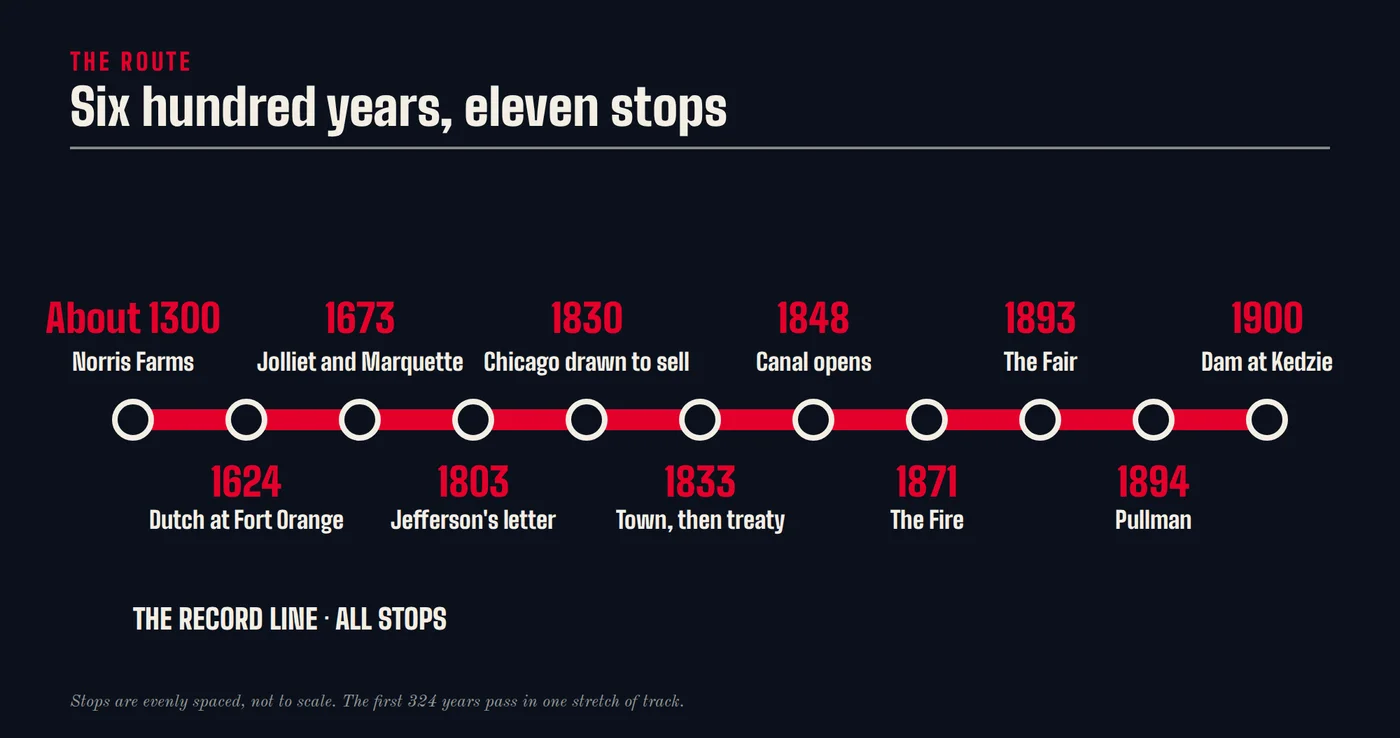
It starts about the year 1300, on a bluff above the Illinois River near Dickson Mounds, at a village archaeologists call Norris Farms. The people buried there tell a hard truth. A great many of the adults died violently. People fought over this country long before any European set foot on it. We start there on purpose. This is a story about ground worth fighting over and the people who figured out how to profit from the fight.
The ground is the portage. About six miles of wet prairie where a canoe could cross from the Great Lakes to the Mississippi. In a wet spring you paddled it. In a dry August you carried. Whoever held the carry could price everything that crossed it. Archer, Ogden and Milwaukee avenues still run along the old trails that fed it.
The nations who lived and traded here were many, and they were separate. Potawatomi. Ojibwe. Odawa. Myaamia. Inoka, the Illinois. Ho-Chunk. Menominee. Sauk. Meskwaki. Kickapoo. Mascouten. Wea. Piankashaw. Separate governments, separate interests, and they did not all get along. That matters, because the men who came later learned to use it.
The first hand in this game was dealt from a thousand miles away. In 1624 the Dutch set up Fort Orange on the Hudson River, where Albany sits today, to buy beaver. They paid in goods and guns, and the guns went to the Haudenosaunee. Armed and hungry for furs, the Haudenosaunee pushed west. Nations out here were scattered, swallowed up or driven off, and by the late 1600s the Illinois had been pushed south out of their own villages. Historians call it the Beaver Wars. A hat fashion in Europe paid for seventy years of war in the middle of this continent. The Dutch never had to come west to do it. That is the first lever on this ground, and it was pulled from a trading post on somebody else’s river.
In 1673 two Frenchmen, Jolliet and Marquette, were shown the portage by people who already used it. Jolliet went home and pitched cutting a canal through it. The first official European act on this ground was a construction proposal.
From there you will see the same moves again and again, run by the Dutch, then the French, then the British, then the Americans, and later by bankers and developers who never held a musket. We call them the levers, often pulled two and three at a time.
One of them was written down by a president. In 1803 Thomas Jefferson told William Henry Harrison, in a letter marked private, to be glad to see influential men run into debt at the trading houses, because once the debt passed what they could pay, they would settle it with land. That is the method, in his own hand, the same year Fort Dearborn went up.
It worked. In 1830 a surveyor drew Chicago’s first map to sell lots and pay for a canal. Chicago was not founded. It was issued. For three years the lots sold slow and cheap. In August 1833 about 350 people organized a town. Six weeks later the Treaty of Chicago took about five million acres from the Ojibwe, Odawa and Potawatomi, paid partly in debts wiped off the traders’ books. By 1836 the same lots were selling at New York prices. The land was never worthless. It was occupied.
Chicago was not founded. It was issued.
The land was never worthless. It was occupied.
The Record follows that thread through the canal, the Fire, the Fair of 1893, where Simon Pokagon sold The Red Man’s Rebuke on birch bark at the gate, and Pullman, where the company cut wages and kept the rent. It ends this stretch on a freezing morning, 2 January 1900, when a few trustees cut the last dam so the river would run backward before Missouri could get a judge to stop them. By the time Missouri got to court there was nothing left to stop.
Here is how to read it.
We print the outcome. Who scored and who got dunked on. We name the money and the people who moved it.
We name every play the first time it is run, so you can spot it the next time.
We lean on the paper trail, not on legend, and we do not lean on French records alone. Where a document is missing we say so and call it a hole.
The Record is never finished. We add to it as we dig. When we are wrong, we print the correction with a date on it, on this page, where anybody can find it.
Nobody who was wronged here gets ranked against anybody else who was wronged. Naming everyone is memory, not a contest.
Read it from either end. It all connects.
The chapters
- Chapter One · About 1300 to 1763The CarryBefore there was a Chicago there was a six-mile walk through wet prairie. Whoever held it priced everything that crossed it. The fight over that walk is older than any flag.
- Fort Orange · 1621 to 1701The Beaver and the GunA trading post on the Hudson River sold guns for beaver and never sent a man west. Seventy-seven years later a deed signed in that same town had Chicago written on it.
- Chapter Two · 1763 to 1849The Ditch and the DeedHow a president’s private letter, a killed public store, a map drawn to sell lots and a treaty signed six weeks after the town turned the carry into Chicago.
- Chapter Three · 1848 to 1893The Franchise and the FireThe streets leased for a century, a city burned and rebuilt in steel, a bomb and a rope, and the streetcar king who taught the city what an alderman’s vote was worth.
- Chapter Four · 1893 to 1900The White City and the Company TownA world’s fair that paid its stockholders a dime on the dollar while its directors’ businesses cashed in, a model town that cut wages and kept the rent, and a river turned around before a judge could stop it.
- Coming nextThe Combine, 1900 to 1913The dinner in New York, U.S. Steel, and a city named after the chairman.
The corrections, printed 15 September 2026
This paper starts with a correction on purpose.
The Record is the foundation everything here rests on, and it went up with mistakes in it. That is what happens when one person writes six thousand words from primary documents. The fix is not to write fewer words. The fix is to print the errors under a headline, dated, where anybody can find them.
Corrections run on this page, under their own headline. Not at the bottom of page thirty-two in six-point type.
One · The town came before the treaty
What it said: Chicago incorporated as a town the year after the treaty, with about 350 people in it.
Wrong, and wrong in the direction that let us off easy.
The Town of Chicago was organized on 12 August 1833. The Treaty of Chicago was signed on 26 September 1833. The town came first, by about six weeks. The city charter came later, on 4 March 1837.
So the sequence is not that a cession opened the ground and a town followed. Three hundred and fifty people. An election. Trustees. All of it six weeks before the treaty that took the country around it. Corrected 30 September 2026. An earlier version of this line said the 1833 town had a charter and sat on ground not yet bought. The town had trustees, not a charter, which came in 1837, and the town site itself had been ceded earlier.
Our read is this. The timing was no accident.
Two · The removal clock was split in two
What it said: they were given three years to leave.
The treaty is not that tidy. The Illinois land was due on ratification. The country north of the Illinois state line was the part held for three years.
"Three years to leave" is the gentle version of a document that ran two clocks at once, and the faster one covered the Illinois ground around this city.
Three · The creditors need two numbers, not one
What it said: creditor claims came to about $175,000 out of a package of roughly a million dollars.
The $175,000 is right. That is the total of the claims scheduled in the treaty. But the treaty also budgeted $150,000 to pay the claims the nations actually admitted.
Both numbers belong in The Record. The gap between what was claimed and what was admitted is the reason the United States Senate looked at that pile and concluded it was inflated. Without both figures, that judgment has nothing to stand on.
The three commissioners on the government's side of that table were George B. Porter, Thomas J. V. Owen and William Weatherford.
Four · A hundred and eighty-nine years
The Record says the Miami-Illinois word for wild onion has been on this city's letterhead for a hundred and eighty-nine years. That figure counts from the city charter in 1837. Counted from the town in 1833 it would be a hundred and ninety-three.
Small. Printed anyway.
Five · The day the council sat
What it said: talks were to open on the twelfth, and the council did not sit until the fourteenth.
The negotiations at Chicago ran roughly from the tenth of September to the seventh of October, 1833. The fourteenth rests on a single eyewitness account. Other accounts put the substantive council closer to the twenty-first.
Until we can name the witness in the copy, that line now reads mid-September and nothing narrower.
Six · The oldest play
What it said: that force as the collection department was first run at Detroit in 1712, and that it was the oldest play in this Record.
It was run here in September 1680, when the great Illinois village near Starved Rock was attacked and its people driven west of the Mississippi. It was run on the Wendat in 1649 before that. We wrote the first chapter before we dug the one that sits behind it.
The Carry now says 1680. The Fort Orange chapter carries the rest. Printed 1 October 2026.
The Record is a living document. It will be corrected again, and each time it is, the correction runs here with a date on it.
A paper that follows other people's money has no business hiding its own mistakes. We do not get a pass.
Read next
The RulesSeven positions, fourteen rules, and who held what.
Chicago sold its parking meters again, 46 to 3What the city got, who cashed out, and why drivers pay until 2084.
Aldermen spent their meter votes on a sealed promiseThe deportation airline, the sealed certification and the buyer with no name.