Business
The Cost of Hope
Kalshi traded $60 billion in September. The people who can’t stop get folding chairs and stale coffee.
By Jason C. Wandel and Claude for Chicago Register · Sunday, October 11, 2026
On Friday the Commodity Futures Trading Commission @CFTC, Washington's referee for markets, made its move on your phone whether you knew it or not. A bet at a sportsbook is gambling and belongs to the states. That part is now a rule. The same bet on an exchange like @Kalshi is a ‘financial contract’ and belongs to Washington. That part is proposed, and the comment box is open. The agency's own rule says a person “can achieve similar economic exposure” either way.
They're selling hope. A dream. A hundred bucks gets you two hundred. Free money.
At most state sportsbooks the guy on the phone has to be 21. Kalshi takes him at 18. @CNN figured traders under 21 put about $5.4 billion through Kalshi this year, by the end of August. Kalshi's own number for that slice is 3.14 percent of its business. Two decimal places. The company knows to the penny how much of its money comes from kids too young to bet at most sportsbooks.
Nobody anywhere can tell you how many of them are hooked.
At a sportsbook the state makes the house honor a ban list, post a help line and answer to a gaming board when he complains. Washington requires none of that. Kalshi offers its own breaks, its own deposit caps and its own ban list. In April it joined a private list run by a company called IC360 that covers only the companies that sign up. Pennsylvania's list doesn't reach it. Neither does ours. Every one starts the same way. You raise your own hand and grade your own homework. Line them up and every player is making their best move.
The states legalized sports betting for the tax money. Last year sportsbooks paid $3.71 billion in taxes nationwide, up a third in a year. Illinois's cut was $593 million, about one dollar of every six. That's a lot for one state, and it's no accident. Illinois takes up to 40 percent of what the books keep, plus a charge on every single bet, the first state to do it. Count the casinos and slot machines too and Illinois took in $2.7 billion from gambling last year, a record. The casinos are guarding licenses they paid for. Their lobby, @AmericanGaming, told Congress the states and tribes are ‘out’ $1.2 billion in taxes. That's the lobby's number.
The sportsbooks quit that lobby last November to get through the same door. @FanDuel and @DraftKings both sell their own versions now. The league wants a clean game. And a clean cut. FanDuel, DraftKings and @Fanatics are its official ‘sportsbooks’. The prices weren't made public. Anybody watching games this season knows what it buys. FanDuel and DraftKings run commercials like someone pushing a Christmas ham. The same two companies that quit the casino lobby. The @NFL bans ads for their Kalshi lookalikes during its games, so on Sunday they sell the sportsbook. Everywhere else the doors are open. @Polymarket pays LeBron James about $15 million a year to sell it. Giannis Antetokounmpo owns a piece of Kalshi. The Chicago Blackhawks @NHLBlackhawks were the first U.S. pro team to sign with Kalshi. The Los Angeles Dodgers @Dodgers and Boston Red Sox @RedSox followed. The New York Yankees @Yankees went with Polymarket. The @NHL made both companies official partners. @CNBC and CNN signed with Kalshi, FOX runs Kalshi's numbers in the news. By the NFL's own count, of the $3.3 billion traded on these exchanges the first Sunday of the season, $1.8 billion was on NFL games. The league can keep the ads off the screen, but not bets off phones. Kalshi found a door Washington left open and walked through it. It traded about $60 billion in September. A year earlier it was $2.8 billion. Its investors valued it at $22 billion in May. The regulator is claiming high ground. The commission is supposed to have five members. It has one, Chairman Michael Selig. His advisory committee seats the heads of Kalshi, Polymarket, FanDuel, DraftKings, @RobinhoodApp and CME. His proposed rule from Friday covers contracts on sports, politics, culture and weather. Betting on who wins an election is about to be federal finance.
The midterms are November 3rd.
I remember Terry Duffy as front month broker in the cattle pit at the MERC back in the day. He runs the joint now. The CME Group runs the FanDuel version of this. In March Duffy told Reuters the line between a hedge and a bet has blurred. Then he gave it a test. “But if you were to say that a player will get four rebounds rather than five,” he said, he would ask “what is the economic sense in that?” He understands the game as well as anyone. Count your change.
The president's son is a paid adviser to Kalshi. He got his stake when the company was worth under $2 billion. It's worth $22 billion now. His investment firm has about $500 million in Polymarket. Kalshi spent $990,000 lobbying Washington in the first six months of this year. Counting the outside firms it hired, nearly $1.8 million. More than all of last year. That buys a spot on the field where the plays are run. The deal room.
Nobody on this list is the proverbial ‘bad guy’. It is an impossibility. Every paycheck comes out of the same losses. The fight isn't over whether someone gets hooked. It's over who gets to collect when they do. The money is the prize and we have no seat at the table.
So how many of ‘him’ are there?
Illinois counted once. The survey started in 2020 and came out in 2022. It found about 383,000 adults with a gambling problem and 761,000 more at risk. The state's own reporters at @CapitolNewsIL say sports betting “wasn't yet fully implemented” then.
I'd say. It has since grown past $15 billion wagered a year. The next count is planned for 2027. It does not include Kalshi or adjacent. Kalshi didn't offer sports until 2025. Nobody in that count was on one. The kids who moved $5.4 billion through Kalshi this year aren't in it. Kalshi isn't the only one. People are answering a survey about themselves. Everyone grading their own homework.
Which brings us to our Honorable Mention Award. Wives, husbands, brothers, sisters, mothers, fathers and friends. The ones lending money to the person in the hole.
You know the one. Grocery money. Mortgage money. Nobody counts them. The lender.
Press this against what we know. The count is from the pandemic. It misses Kalshi and tech companies of this ilk. It only caught the people willing to say it out loud. On one particular afternoon. Of the ones who never asked for help, 45.7 percent thought they could fix it alone and 44.6 percent were too embarrassed or worried to ask. Illinois's own survey counted help from friends and family as help. And the state's $4 million ad campaign produced about 3,200 treatment referrals. Against the rapidly aging count of 383,000, that's one in 120.
383,000 is a very kind number.
The studies that found something didn't ask anybody anything. Three researchers at UCLA and University of Southern California pulled the credit files of 4.38 million people. Where sports betting went online, the chance of a personal bankruptcy filing rose 25 to 30 percent. That study ran through June 2023. It measured the years before this wave. A Northwestern University team found every dollar bet meant about two dollars less saved. But this isn't a finance lesson. The person won't tell you. The paper will. Hidden addictions leave a money trail, and that's the one trail this paper knows how to follow. Nobody knows the real number. The people living it aren't going to say, and the only ones counting are counting the profits.
Counselors call gambling the hidden addiction for a reason. A drinker reeks like booze. You can smell weed. It sticks to your clothes. Ever been around a speed freak or cokehead? Enough said. A guy going under on his iPhone looks like a guy checking his email. Having a coffee. He may be wearing a suit. He hides it from everyone else. All addicts do. We are very adept at protecting ourselves.
Then ‘the costume’ hides it from the player. We wrote it Thursday. He doesn't feel like a guy in trouble. He feels like he's having a rough quarter. He's a trader. He's got some exposure. He rotates his portfolio. X ‘analysts’ are the smart money. He's in finance now. Part of the club. You can't confess to something if you think it's your job.
NPR found one of them. ONE. He's 35, lives in Pennsylvania and works in financial services. He was about $75,000 in debt, more than $50,000 of it from online sportsbooks. He filed for bankruptcy in 2023 and put himself on his state's ban list. That list doesn't reach Kalshi. Two years later an Instagram ad offered him $20 for his first $10. He went more than $25,000 down, mostly on bitcoin contracts that settle every 15 minutes. He asked four times to be shut out before Kalshi did it. A Kalshi spokeswoman called it “a cherry-picked case.” A therapist told @FortuneMagazine these markets “tend to feel more socially acceptable” than a sportsbook. Not exactly comfortable dinner conversation.
In my 30s I walked the Financial District in a Boss or Armani suit, making pitches and cutting deals in between a shot and a beer. I was the guy walking down Market Street with confidence and a smile. I had it all figured out. No survey had me. No state report. No help line log. I would have told the stranger on the phone I was fine or hung up on them and felt uncomfortable or annoyed for about one second, long enough to walk over to The Royal Exchange for a Jameson. And a beer. It took me the better part of my 30s to own an alcohol and drug addiction. I wasn't on anyone's report card.
Here's the full picture, so nobody can say we cherry-picked.
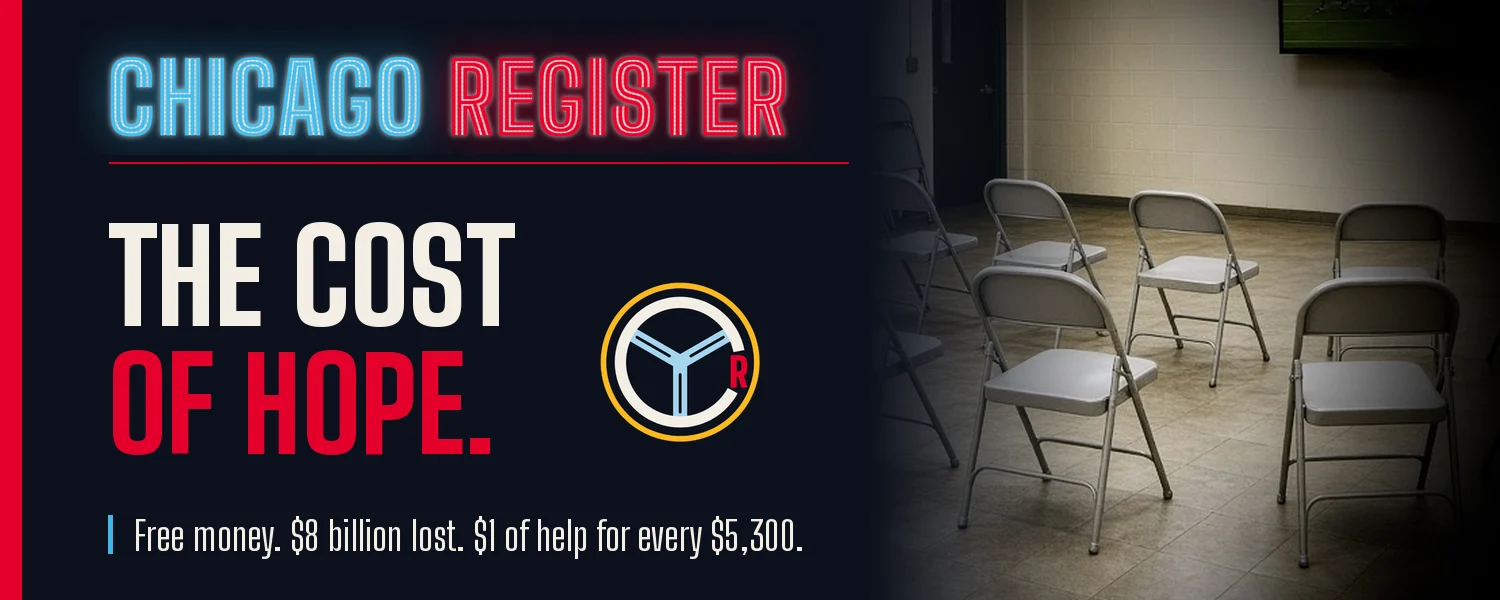
Illinois gamblers lost nearly $8 billion last year. The state set aside $15 million for treatment and prevention. The governor's office calls that a 1,400 percent increase. The year before, it spent $10.8 million on treatment, training and outreach combined. What reached treatment itself has averaged about $1.5 million a year since 2020. $1.5 million against $8 billion is $1 of help for about every $5,300 lost. Use the state's best number, the $15 million, and it's $1 for about every $530. Until this July, Illinois paid for a gambler's inpatient treatment only if he also had a drug or alcohol problem. The new law fixed that. It came with no new money. The state's campaign is called “Are You Really Winning?” It asks the gambler. The player. The state took in $2.7 billion and asks him. The industry's phrase for all of it is “responsible gambling.” The word responsible is pinned on the customer every time. Never on the house, the company's app or the statehouse. The help took the money too. Kalshi joined the National Council on Problem Gambling in May and pledged $2 million. The council made a new member category for it, “financial services and trading companies.” Nevada's council and the Evergreen council quit over it. So did Michigan's gaming board. The city reaches into the same drawer. Chicago promised its casino money to the police and fire pensions. Then its new budget legalized video gambling machines in bars and put a tax on sports bets expected to bring in about $26 million. The sportsbooks sued to stop the tax. A city consultant warned the machines could cost the casino nearly 400 jobs.
The state is on that list of paychecks too, and may be the most hooked one in the room. It can't afford for people to stop. $8 billion lost by Illinois gamblers isn't a problem in Springfield. It's a revenue forecast.
Blame is a convenient exit ramp. Everybody points at everybody else, and the guy on his iPhone at 2 a.m. is still on his iPhone.
It's an old move. The can and bottle makers paid for the litterbug ads. The tobacco companies called it personal choice. The problem gets handed to the one person who has it. The church basement tells the same story from the other end. The thing that causes it gets a $60 billion month and a federal rule. The thing that treats it gets folding chairs, stale coffee and volunteers. It's a raw deal. It is difficult to see from outside because each piece looks reasonable by itself. An ad that says get help. A ban list you sign yourself. A program that says look at yourself. A family that says just stop. Any single one sounds like care.
Stack them up for twenty years and what you hear is one sentence, over and over.
It's YOU. YOU ARE THE PROBLEM.
The shame and guilt do the system's work for free. A guy who's ashamed doesn't talk. A guy who doesn't talk doesn't get counted. And he doesn't get help.
It's hard to see for a reason. You never meet a system. You meet a person. A clerk, a boss, a counselor, a guy at a bar. Each one is holding up their end of the log, so it never looks like a machine. A system. It looks like a string of moments.
You only see it when you step back far enough to notice the same thing happening at large, in the same way, no matter who's standing at the counter. This concept is not exactly new either. And it's a pretty good one. Get a crowd to put money on what they think will happen and the price tells you something no pundit can. Economists ran small versions at universities for decades and nobody got hurt. Once the venture money arrived, all bets were off. The same few shops that paid for Robinhood, @DoorDash and Coinbase are in Kalshi.
A $22 billion valuation needs a $60 billion month. Then it needs a bigger one.
Volume from casual users doesn't cover that nut. It comes from institutional money. From whales.
Chicago's own Jump Trading @jumptrading gets stock in Kalshi and Polymarket for taking the other side of customers' trades. Kalshi's own trading unit takes the other side of some bets. Kalshi says “Our profits aren't tied to trader losses.” They do collect a fee on every trade. Simply put, the more someone trades, the more it makes. The business needs the guy who can't stop, whether anyone planned it or not. Every growth trick points the same way. The $20 bonus for a first $10. The Instagram ad. Contracts that settle in 15 minutes so there's always a next one.
Open all night. They don't bring you a cocktail yet. That's DoorDash's job.
Nothing in the tech playbook has brakes. It never did. A corner bookie cuts you off when you're in too deep. You also may take a different way home or hide when you are in that situation. Promise to pay and charity isn't part of the bookie business model. Kalshi, FanDuel and DraftKings have no reason to cut you off.
Prohibition ended in 1933, four years into the Depression, sold as jobs and tax money. Lotteries came back in 1964 and spread as states ran short. Colorado sold legal weed in 2012 on jobs and school money. Illinois legalized sports betting and six new casinos in 2019 to help pay for a $45 billion building plan.
Hard times, a broke government and a vice waiting to be taxed.
There's a growth engine strapped to addiction. The engine doesn't care what it runs on.
Sources
The record
- The rules. CFTC, Friday’s rule that sportsbook bets are not swaps, CFTC, Friday’s proposed rule putting event contracts under Washington, SBC Americas on the rule and its “similar economic exposure” line.
- The kids. CNN on the $5.4 billion traded by Kalshi users under 21, PGRI on Kalshi’s own 3.14 percent figure, DeFi Rate on Kalshi’s breaks, caps and self ban, PlayUSA on Kalshi joining IC360’s SelfExclude.
- The tax money. American Gaming Association, 2025 national totals, Capitol News Illinois on the state’s record $2.7 billion, Legal Sports Report on Illinois’s sports betting tax, Nelson Mullins on the first per bet tax in the nation, CDC Gaming on the casino lobby’s testimony to Congress, Front Office Sports on FanDuel and DraftKings quitting the casino lobby.
- The leagues, the players and the networks. Covers on the NFL’s sportsbook deals, Gaming.net on the NFL’s prediction market ad ban, Gambling.com on the NFL barring its partners’ prediction market ads, Front Office Sports on LeBron James and Polymarket, iGaming Business on Giannis Antetokounmpo and Kalshi, Bloomberg, via Advisor Perspectives, on the Dodgers, Red Sox, Yankees and NHL deals, Covers on the Blackhawks and Kalshi, The Block on CNBC and Kalshi, The Block on Fox and Kalshi’s numbers, The NFL’s brief to the Supreme Court, with the first Sunday numbers, Supreme Court docket, Flaherty v. KalshiEX.
- The company and the regulator. Prediction News on Kalshi’s $60 billion September, TechCrunch on Kalshi’s $22 billion valuation, Bloomberg Government on the chairman ruling alone, Bitcoin.com on who sits on the chairman’s advisory committee, SiGMA, relaying Reuters, on Terry Duffy, CME Group on its FanDuel partnership, Financial Times reporting, via MarketScreener, on Donald Trump Jr.’s Kalshi stake, Covers on the same stake, CoinDesk on 1789 Capital and Polymarket, CDC Gaming on Kalshi’s lobbying.
- The count. State of Illinois, the problem gambling survey, Capitol News Illinois and Illinois Answers on treatment money, The bankruptcy study itself, UCLA and USC, UCLA Anderson Review on the bankruptcy study, The savings study itself, Northwestern and others, Kellogg Insight on the savings study, NPR on the Pennsylvania man, Fortune on prediction markets and addiction.
- The help. WTTW on the new inpatient treatment law, Illinois Helpline, the state funded “Are You Really Winning?” campaign, Axios on Kalshi and the national council, WTTW on Chicago’s 2026 budget, WTTW on casino money for police and fire pensions.
- The engine. Food On Demand on Sequoia and Coatue in DoorDash, Clay on Sequoia and IVP in Robinhood, Casino.org on ARK in Kalshi, Robinhood and Coinbase, CoinDesk, relaying Bloomberg, on Jump Trading, Bloomberg, via Advisor Perspectives, on Kalshi’s own trading unit.
- The old move. History.com on the Depression and the end of Prohibition, Tax Foundation on how taxes led to repeal, Christian Science Monitor, 1983, on pinched states turning to lotteries, Stateline on Colorado’s legal weed pitch, Fox 32 on the $45 billion building plan and expanded gambling, KFVS on gambling money backing the building plan.
Cover art by Jason C. Wandel.
Run it back
The seating chart. First run 1629. Still running.